Technical guides
Flange types: slip-on, blind, weld neck and threaded
A flanged joint is three parts working together: the flange, the gasket and the stud bolt. People order one and forget the other two more often than seems reasonable.
A flange exists so a run of pipe can be dismantled without cutting it. That is its whole purpose, and the first criterion follows from it: if a point on the line will never be opened, it may not need a flange; if it will be opened every shutdown, it does.
Slip-on flange
It slides over the pipe end and is welded outside and inside. It is forgiving in assembly — small position adjustments are possible before welding — cheaper than weld neck, and adequate for most service lines.
Its limit is fatigue. The geometric discontinuity between pipe and flange concentrates stress, so at high pressure or under severe thermal cycling it is not the choice.
Weld neck flange
It has a tapered hub butt-welded to the pipe with the same wall thickness. That continuity is what makes it the flange for high pressure and thermal cycling: there is no abrupt change of section for stress to concentrate at.
It costs more and demands greater cutting and alignment precision, because a butt weld does not forgive misalignment. It is the flange of serious process lines.
Blind flange
It closes an end. It is used to cap a branch, to leave a point ready for future extension, and as an inspection closure at a point opened periodically.
It has one further use worth remembering: hydrostatically testing a section before connecting the rest of the installation.
Threaded flange
It screws onto the pipe with no welding. It is the answer where welding is not possible: fire-risk areas, lines where hot work is not authorised, small diameters in service installations.
It is not a high-pressure or thermal-cycling flange, because the thread is a weak point against fatigue and leakage.
Pressure class is not optional
Two flanges of the same nominal diameter but different class do not mate: the bolt circle, the number of holes and the thickness all change. Asking for “a 6-inch flange” without the class is asking for half a specification.
And pressure class is not the same as working pressure: real capacity also depends on temperature and material. The higher the temperature, the lower the allowable pressure for the same class.
Facing and gasket go together
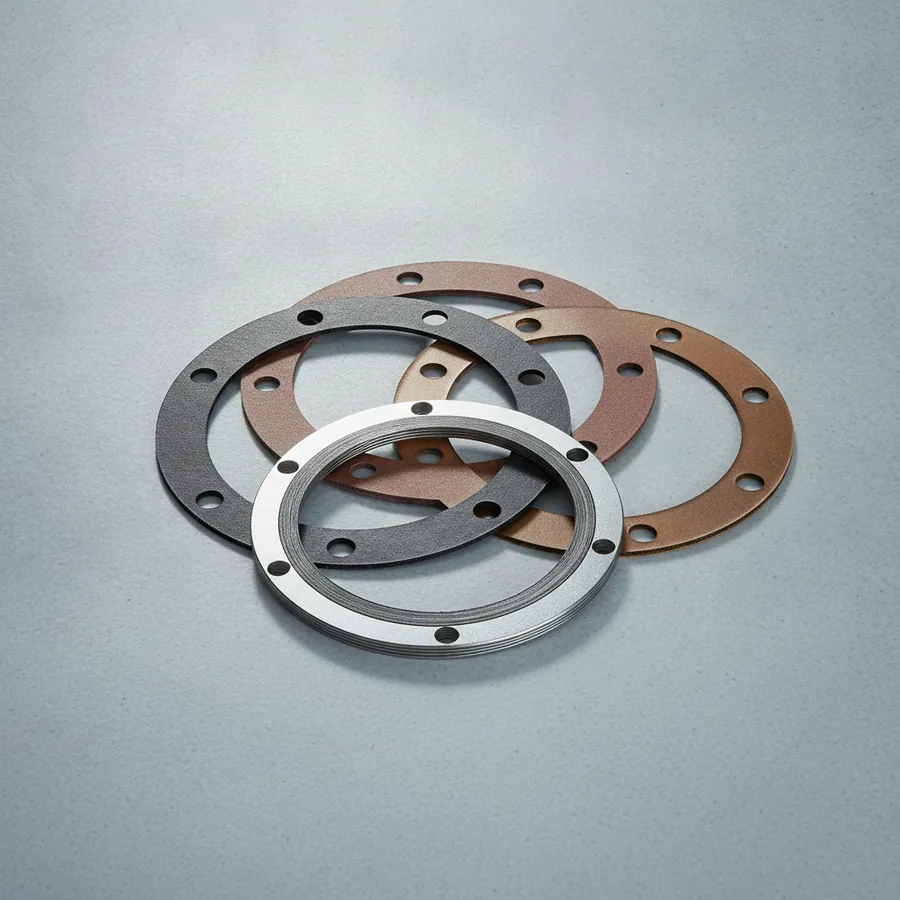
The facing type — raised face, flat face, grooved — determines which gasket applies. A flat gasket on a facing that called for a ring, or the other way round, will not seal even if the material is right.
That is why the joint is quoted complete: flange, gasket and the set of stud bolts with nuts. Ordering only the flange guarantees a second urgent purchase on assembly day.
Minimum list to quote a flanged joint
- Nominal diameter and pressure class.
- Flange type: slip-on, weld neck, blind or threaded.
- Facing type.
- Flange and stud bolt material.
- Fluid and temperature, to define the gasket.
- Number of joints, to work out the full bolting set.
Frequently asked questions
No. Even if the nominal diameter matches, the bolt circle, hole count and thickness change. You have to match the class or use a transition piece designed for it.
At high pressure, on lines with thermal cycling and wherever fatigue is a factor. Slip-on is adequate and more economical on service lines under moderate conditions.
The gasket matching the facing type and the fluid, and the complete set of stud bolts with nuts. Those are the two parts most often missing on assembly day.