Technical guides
HDPE or steel pipe: which one suits each run
The argument is usually framed wrong. It is not about which pipe is better, but about which run you are facing: the ground it crosses, the fluid it carries and who is going to install it.
In Panama two factors push the decision harder than price per metre: humidity — which decides how long buried steel lasts — and ground movement in the rainy season, which decides whether a rigid line will work in tension where it should not.
Where HDPE wins
It does not corrode, and that changes the maths
High-density polyethylene is chemically inert to water, acidic soils and much of what flows in effluent lines. It needs no cathodic protection, no external coating, and none of the maintenance buried steel requires to reach its theoretical service life.
On a buried run with permanent humidity, the real cost of steel is not the pipe: it is digging it up again.
The fused joint removes the joint
Two HDPE runs fused together form one continuous piece, with no mechanical joint to torque, inspect and re-torque. On a long line that means fewer potential leak points and less scheduled maintenance.
That is the fundamental difference from any flanged or threaded system: there is no sealing element that ages.
Flexibility and weight
HDPE tolerates ground settlement that would crack a rigid line, and it is handled on site without a crane in ordinary diameters. On long runs it installs in continuous lengths, with fewer joints and a smaller crew.
Where steel still rules
Pressure and temperature
HDPE has a temperature ceiling that rules it out of hot lines, and its allowable pressure drops as working temperature rises. Steam, condensate and hot process lines are steel territory, no argument.
Severe abrasion
For mineral slurry with coarse particles at high velocity, neither plain HDPE nor bare steel survives: the answer is steel pipe with an internal rubber, ceramic or polyurethane lining. That is a third category, not a midpoint.
Structure and support
When the pipe also works as a structural element, or when supports are widely spaced, steel is the answer. HDPE needs more continuous support because it deflects.
The questions that usually decide it
Before comparing prices it is worth answering five things. With them the choice stops being a preference and becomes a consequence:
- Operating temperature, including peaks.
- Working pressure and whether there is water hammer.
- Is it buried, exposed or submerged?
- Does the fluid carry suspended solids, and of what size?
- Is fusion equipment available on site, or does it have to be planned for?
That last point gets forgotten often and it drives the schedule: HDPE is cheaper to install only if the fusion equipment and trained crew are available when the work front needs them.
The mixed case, which is the most common
Most projects do not choose one or the other: they use HDPE on buried and conveyance runs, and steel in process areas, at road crossings and wherever the line connects to equipment.
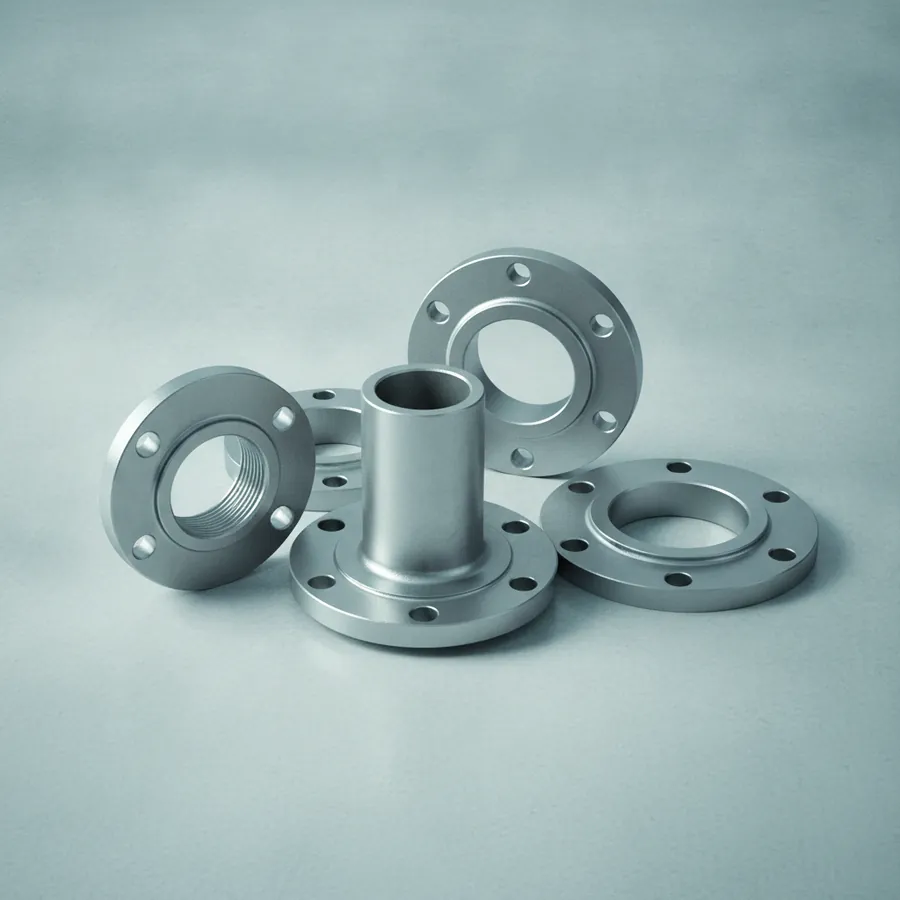
The transition is solved with an adapter flange (a stub end with a backing ring), which lets the run be dismantled without cutting the line. It is worth putting on the bill of materials from the start, because it is the piece that tends to be missing on assembly day.
Frequently asked questions
Yes, it is one of its main uses, including the co-extruded type. You need to request material with the corresponding potable-water certification and state it in the enquiry, because it drives the source and the lead time.
With an HDPE stub end and a metal backing ring. It is a dismountable joint, so it is worth including it in the bill of materials at design stage rather than solving it in the field.
You can, but permanent soil humidity shortens service life well below the theoretical figure. If the run is buried and not critical on temperature or pressure, HDPE usually works out cheaper over the full cycle.